
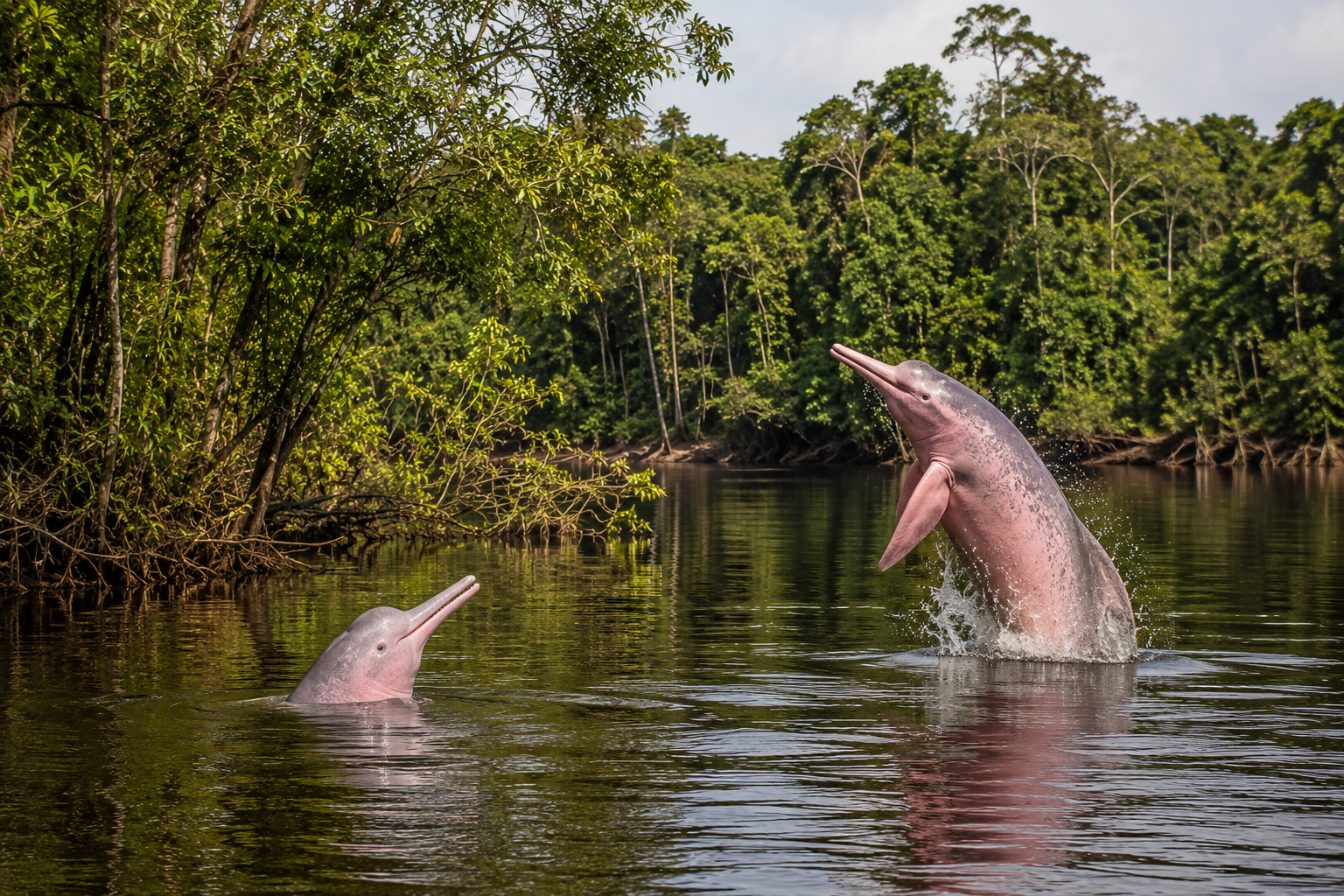
Click the Pink Dolphins Image for an inspirational video about Nature Sounds
What is the Nature Sounds Archive?
NSA is a collection of natural sounds that began in the 1980s at Texas A&M University-College Station. A natural sounds collection is a curated set of audio recordings that document sounds occurring in the natural environment, including vocalizations of wildlife (such as bird calls, insect stridulations, frog choruses, and mammal calls), as well as non-biological ambient sounds like wind, rain, flowing water, and other geophysical sounds. Such collections are typically gathered for scientific study, ecological monitoring, conservation planning, acoustic ecology, and public education. They may be archived with metadata identifying the location, date, habitat, recording equipment, and species or sound source. Soundscapes, an acoustic rendering that showcases the beauty and diversity of the acoustic environment at a particular place and time, is analogous to a landscape painting, but using sound instead of a brush. Natural sounds have also been used as instruments in composing music (Gorillas In The Mix – by Bernie Krause & Human Remains, 1989)
What is the history of the Natural Sound Collection?
The NSA was conceived and implemented by Dr. Robert Benson, a newly minted cosmic ray physicist who joined the TAMU faculty in 1985. The collection was part of his Center for Bioacoustics. Benson expressed a lifelong fascination with the natural world as a child and wanted to merge his rigorous scientific training with his love for living nature.
Dr. Benson transferred from TAMU at College Station, Texas, to TAMUCC at Corpus Christi, Texas, in 1997. He retired in 2012 and briefly joined the faculty at Coastal Bend College in Beeville, Texas. The collection is now housed at the Duryea Gallery, in Beeville, Texas.
What material is contained in the NSA?
The NSA comprises audio recordings ranging from ordinary backyard birds in Texas to exotic wild creatures from various locations around the world. There are recordings from the Amazon Rain Forest, the Cloud Forest of Mexico, the mountains of Arizona, southern Europe, the islands of the Lesser and Greater Antilles, and the underwater sounds of dolphins and whales in the Gulf of Mexico.
Ongoing work at the Duryea Gallery.
Presently, Dr. Benson is preparing the collection to withstand the rigors of temporal degradation by converting older analog audio recordings (open-reel magnetic tapes, cassettes, tapes of various formats, and even vinyl records) to digitally formatted MP3s. He is also uploading the digital versions to Archive.org, a worldwide depository for nature recordings and many other types of documents.
The Duryea Gallery is open to the public from 10 am until 3 pm each Saturday. Dr. Benson is usually there and is happy to introduce the NSA to the visitors. The Duryea Gallery is located next to the Bee County Courthouse at 105 South Saint Marys Street in Beeville, Texas.